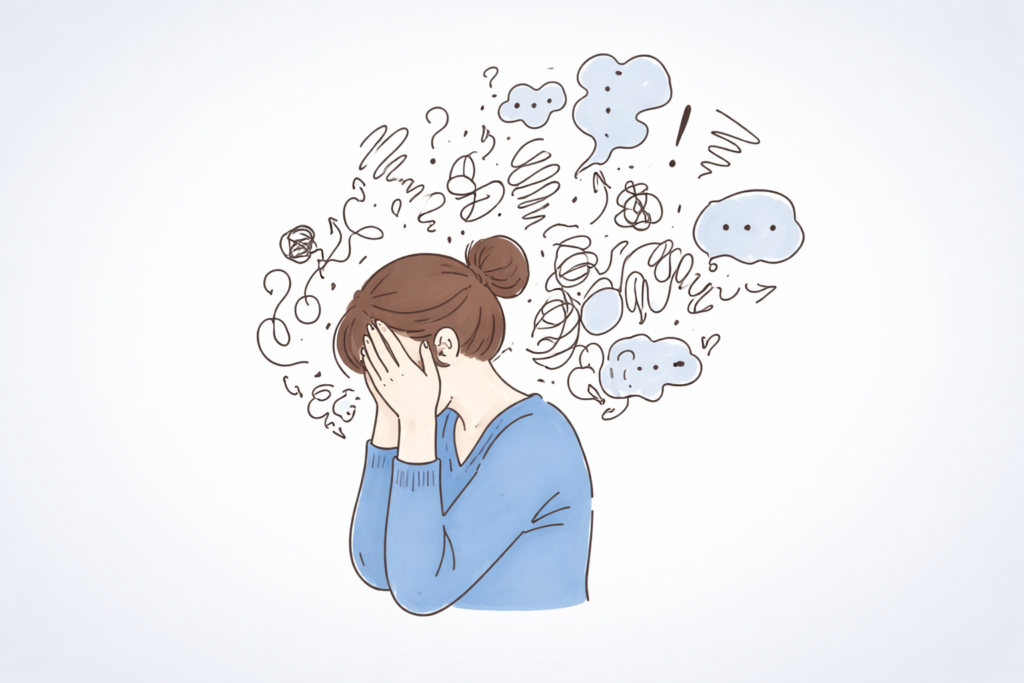
Choosing a spouse can be a frightening prospect. Questions like “How do I know if they’re the one?” or “What if I make the wrong choice?” are natural because committing to a life partner is one of the most life-altering decisions, with no guarantees. For some, though, this normal unease becomes overwhelming, trapping them in endless loops of doubt that prevent them from fully engaging or moving forward.
A certain amount of anxiety, or “cold feet,” is a normal and healthy part of decision-making in dating. It reflects care, responsibility, and awareness of the stakes involved. However, when the anxiety becomes distressing, time-consuming, and interferes with one’s ability to connect, commit, or fully engage in a relationship, it may be a sign of Obsessive-Compulsive Disorder (OCD), specifically a form known as Relationship OCD (ROCD).
What Is Relationship OCD?
OCD causes unwanted, intrusive thoughts (obsessions) and repetitive behaviors (compulsions) aimed at easing anxiety or gaining certainty. Unfortunately, these compulsions only offer short-term relief and often worsen the problem over time.
Relationship OCD
ROCD centers on obsessive doubts about one’s partner or the relationship. Common questions include: Am I truly in love? Is this how I should feel? What if there’s someone better? The mind demands impossible certainty.
To quiet the anxiety, people may repeatedly analyze interactions or compare relationships, seek reassurance from friends, rabbis, or online forums, make endless “pros and cons” lists, or end relationships prematurely to escape the doubt.
Some of these behaviors happen only in the mind. People might replay conversations, test their feelings over and over, or mentally compare their partner to others in search of certainty. From the outside, this can look like normal overthinking, but it is actually a form of compulsion that keeps the anxiety cycle going. These mental loops may bring brief relief, yet the doubt always returns, making it harder to be present and to truly experience the relationship.
Here’s how ROCD might look like in the frum community:
Yaakov is a 26-year-old frum man who’s been dating Rivky for several months. Objectively, Rivky shares his values, is kind, and they enjoy spending time together. However, as the possibility of engagement becomes real, Yaakov finds himself tormented by intrusive “what if” thoughts: “What if I’m making a huge mistake? What if there’s someone I’ll connect with more deeply?” He constantly reviews their conversations in his mind, searching for a moment that will confirm she’s ‘the one,’ and frequently asks his rebbe and close friends for reassurance. Each time he feels a wave of clarity, the doubts creep back in, making him question even more. Yaakov notices these worries take up hours and make it hard for him to be present or enjoy dating. He fears leading Rivky on, yet can’t seem to feel certain enough to move forward.
How to Cope with Relationship-Themed Obsessions and Dating Anxiety
1. Let Go of the Myth of Certainty
If you find yourself overwhelmed by “what ifs,” remember that nobody has absolute certainty that they are marrying the right person. Certainty is not a fact; it is a feeling that fluctuates. Some people feel sure early on, while others never have a lightning-bolt moment, and that can still lead to lasting, loving marriages.
2. Accept Imperfection in Yourself and in Your Partner
People with ROCD often hold perfectionistic expectations: the perfect partner, the perfect emotional state, the perfect love story. In reality, healthy love includes moments of boredom, irritation, and even doubt. Feelings ebb and flow, but that does not mean the relationship is wrong.
Infatuation fades as love matures into something steadier and more complex. That shift is not failure; it is growth.
3. Shift from Compulsions to Values
ROCD sufferers often think, What if my doubts mean I am in the wrong relationship? Unfortunately, there is no test for certainty. What matters more is how you respond to the doubt. If you are chasing constant reassurance, that is likely the OCD talking.
Rather than solving every “what if,” focus on what truly matters:
- What qualities are most important in a partner?
- What kind of life do I want to build together?
- Are there genuine red flags, such as dishonesty or disrespect, or am I chasing an unrealistic sense of perfect comfort?
If there are true red flags, such as dishonesty or disrespect, those should never be ignored. But if the discomfort comes from chasing perfect certainty or perfect feelings, that may be anxiety rather than intuition. Choosing a partner and moving forward in the relationship according to your values is far more important than trying to achieve absolute certainty.
4. Practice Mindfulness
When your mind is busy analyzing, it is hard to experience connection. The more you resist the urge to check, compare, or seek reassurance, the more present you can be. That is how you actually gather real-world information about your relationship: not through rumination, but through experience.
When and How to Seek Help
If your worries feel impossible to shut off or are keeping you from enjoying your relationship, it may be time to reach out for professional help. Early support can make it easier to change these patterns before they take hold.
Therapy for OCD, including Relationship OCD, focuses on learning new ways to respond to intrusive thoughts and anxiety. The most effective treatment is called Exposure and Response Prevention (ERP), a specialized form of cognitive-behavioral therapy that helps people face uncertainty and reduce compulsive behaviors. Acceptance and Commitment Therapy (ACT) can also help individuals reconnect with their core values and live meaningfully alongside doubt, rather than trying to eliminate it entirely.
If you are not sure whether what you are experiencing is OCD, or if anxiety is preventing you from moving forward with someone who may be a wonderful match, specialized care can make all the difference. You deserve a relationship built on connection and presence, not fear and doubt.
Remember that doubt is part of being human. The goal is not to eliminate uncertainty, but to live meaningfully alongside it.